Price Rise Simulation
TL;DR:
A small price rise almost always adds more profit than it costs, because your expenses barely move while the extra revenue drops straight to the bottom line.
A 5% price rise on a 20% net margin lifts profit by about 25%, with no change in volume.
Most businesses can lose more customers than owners expect before a price rise costs them money. At a 40% gross margin, that's about 11%.
The thinner your margin, the more customers you can afford to lose and still come out ahead.
The 5% business owners are leaving on the table
Pricing is the most underrated growth lever in a business, and it's the one most owners are nervous to pull. The fear sits under every pricing conversation: put prices up and customers walk, or the complaints start rolling in. That imagined downside looms far larger in an owner's mind than the upside ever does, so the rise gets put off, year after year.
A lot of the time this is a confidence problem rather than a maths problem. Owners already sense that a small rise would help. What they lack is the experience of watching their own numbers move, and seeing how little has to change for the result to land in their favour.
During Business Growth School we spend a session on this, and playing with the numbers and seeing the potential uplift quickly changes the mindset.
Here's a sneak peek at what we cover on Business Growth School and how a price rise can quickly change your business growth trajectory.
What a price rise does to profit
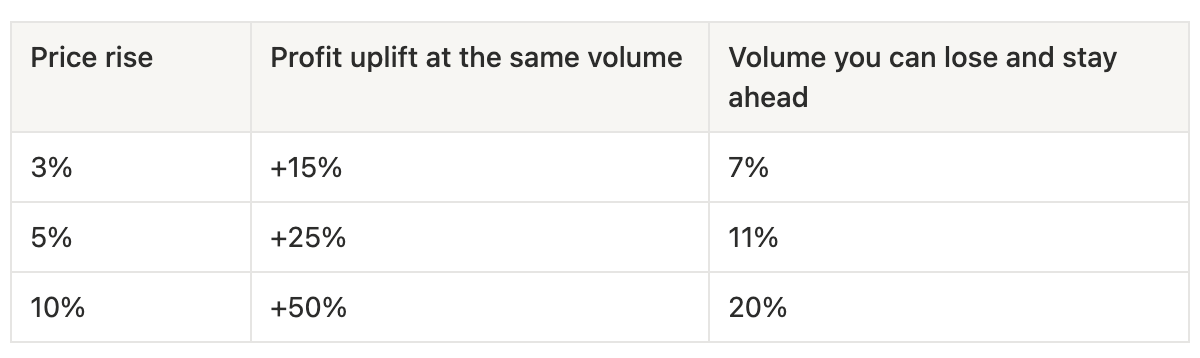
A price rise, held at the same volume, almost always flows straight to profit. Your costs barely move, so the increase lands on the bottom line. The maths is simple: your profit uplift is the price rise divided by your net margin. A 5% rise on a 20% net margin lifts profit by about 25%.
Let's put some real numbers on it. A business turning over a million dollars at a 20% net margin makes $200,000. If they were to lift the price by 5% without any changes to the volume sold, that extra $50,000 of revenue carries almost no additional cost to the business, so profit moves to $250,000. Seems simple. This is the first part.
How much you can afford to lose
One of the biggest fears we hear when talking about a price rise is almost always "But we'll lose customers". This might be true, but the benefit of a price rise may also outweigh the loss of customers, to a point. The second part of this exercise settles the nerves: understanding the volume you can afford to lose before a price rise leaves you worse off. That number is the price rise divided by (gross margin + price rise). At a 40% gross margin, a 5% rise means you can lose about 11% of your customers and your profit will be untouched. Most owners fear the lost revenue from customers would be much higher than that.
Here's the same business again. Revenue $1M with a 40% gross margin, so $600,000 of direct cost and $400,000 of gross profit. If they were to raise their price by 5% and lose 11% of volume, their gross profit remains $400,000. This business now makes the same profit with fewer customers, and less work to service them. Anything short of an 11% loss and you're ahead.
Here's an example of those two scenarios for that business:
The part that reframes it
The thinner your margin, the more volume a rise lets you shed and still come out ahead. At a 25% gross margin you can lose about 17% of your volume, at 40% it's 11%, and a high-margin software business at 85% can only afford to lose about 6%. A trades or manufacturing business can lose more customers from a price rise than a software business can. For the owners and operators in the room, that reframed a price from a risk to an opportunity.
None of this argues for raising prices carelessly or sporadically. The rises that stick tend to be small and regular, timed from a position of strength, and communicated with enough confidence that customers read the price as a signal of value. The starting point is knowing your two numbers, because once you do, the decision stops feeling like a gamble and starts feeling manageable.
The tool each owner walked out with
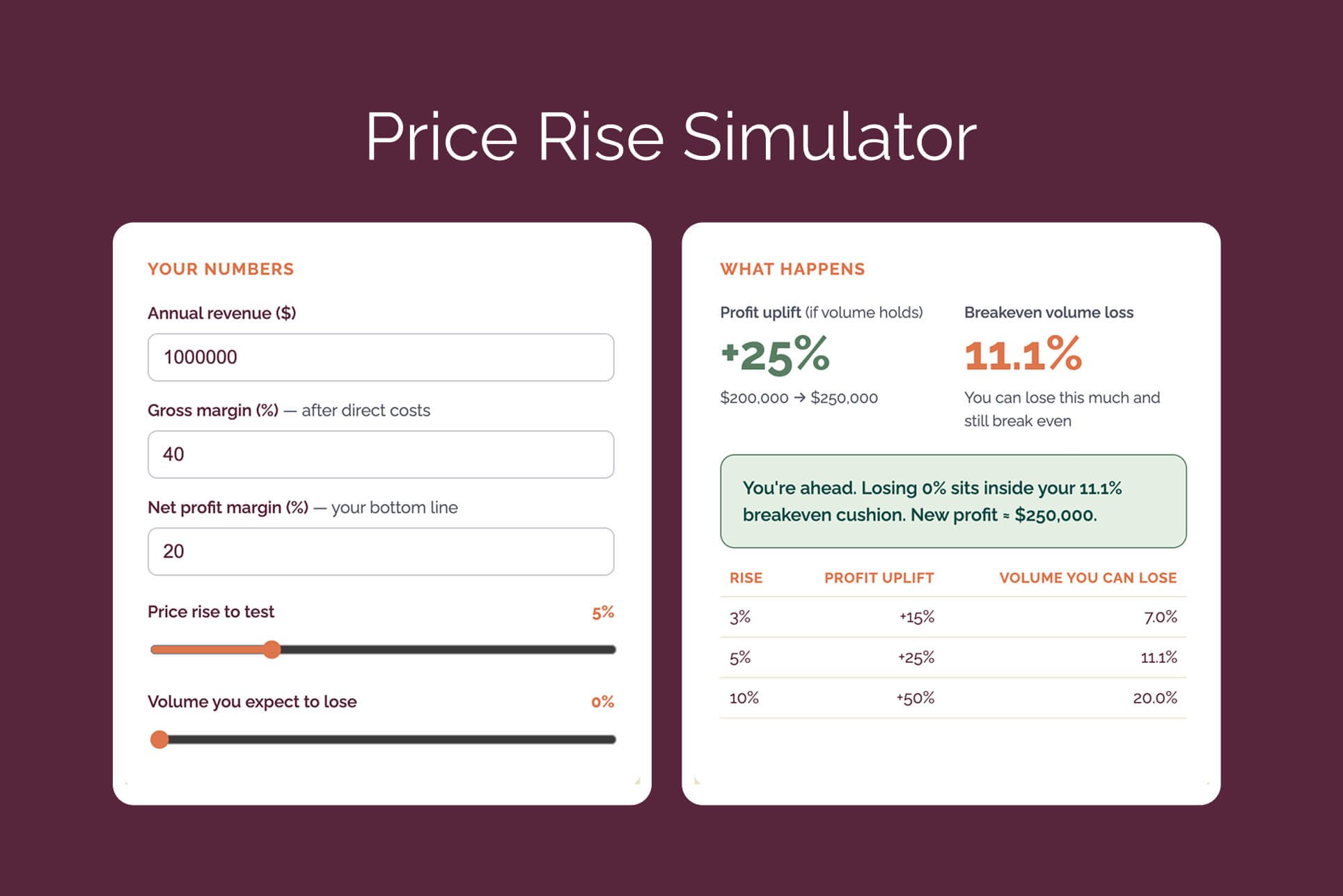
We do this exercise during Business Growth School and it's one of the big unlocks of the day. We don't just share the theory; each participant builds their own price rise simulator using AI, seeded with their own revenue and margins.
Within a few minutes everyone had a working interactive tool with sliders, built for their business rather than a generic template. The conversation shifted from "We know we should..." to "We can and this is how much..." Before we'd even finished the session, they were sharing the tools with their own teams.
You can now build your own tool in minutes, on your own numbers, without a developer or a budget. That's the part of the day people kept talking about.
Try it for yourself on your own numbers
If you want to try it, here's the prompt we use. Just paste it into Claude or ChatGPT and fill in your numbers.
Build me an interactive price rise simulator as a single self-contained HTML page I can preview live (use Canvas or an artifact if you have it). My business is [type], revenue [$], gross margin [%], net margin [%]. Add a slider for the price rise (0 to 20%) and one for the volume I might lose (0 to 40%). Show my profit uplift if volume holds, and my breakeven volume loss, the most volume I can lose before the rise costs me. Add a plain-English verdict and a table at 3%, 5% and 10%. Formulas: uplift = rise ÷ net margin; breakeven loss = rise ÷ (gross margin + rise). Seed it with my numbers.
This is a great tool to experiment with. Run it with your numbers before your next pricing decision. Then show it to your team and turn the price rise into reality.
When did you last run this number for your own business?
If you want your leaders making calls like this on real numbers, that's what our Business Growth School is built for. Drop us a email and book a call if you'd like to know more about the next intake.
Frequently Asked Questions
Will raising my prices lose me customers?
Some, possibly. But a price rise usually still leaves you better off even with a bit of customer loss, because the extra revenue carries almost no extra cost. The real question isn't whether you'll lose anyone, it's how many you can lose before it stops paying off, and that number is usually higher than owners expect.
How much profit does a small price rise actually add?
More than most owners assume. If your costs stay flat, the profit uplift is the price rise divided by your net margin. A 5% rise on a 20% net margin adds roughly 25% to your profit, at the same volume.
How many customers can I afford to lose before a price rise costs me money?
Work out your breakeven volume loss: the price rise divided by your gross margin plus the price rise. At a 40% gross margin, a 5% rise means you can lose about 11% of your customers and still land in the same place. Anything short of that, you're ahead.
Does a price rise work the same for a high margin business as a low margin one?
No. The thinner your margin, the more volume you can lose and still come out ahead. A trades or manufacturing business on a 25% margin can lose around 17% of its volume. A software business on an 85% margin can only afford to lose about 6%. Higher margin businesses need to be more careful with a price rise, not less.
Where can I get help working out my own numbers?
Business Growth School runs a full session on this, where owners build their own price rise simulator seeded with their actual revenue and margins. If you'd rather have someone walk you through it than run the numbers alone, that's what the programme is built for.