
TLDR:
Owners who say they are too busy putting out fires to track KPIs (Key Performance Indicators) are mixing up urgent with important. The numbers are how you find out why the fires keep starting.
A KPI is worth tracking only if it changes how someone works: recognition when it is green, a course correction when it slips, or a tweak to how the work is done. Otherwise it is a vanity metric.
Lead measures show what is coming and lag measures show what already happened. You need a mix of both.
Red, Amber, Green replaces pass or fail with a simple rule: recognise green, leave amber alone, and ask what help is needed on red.
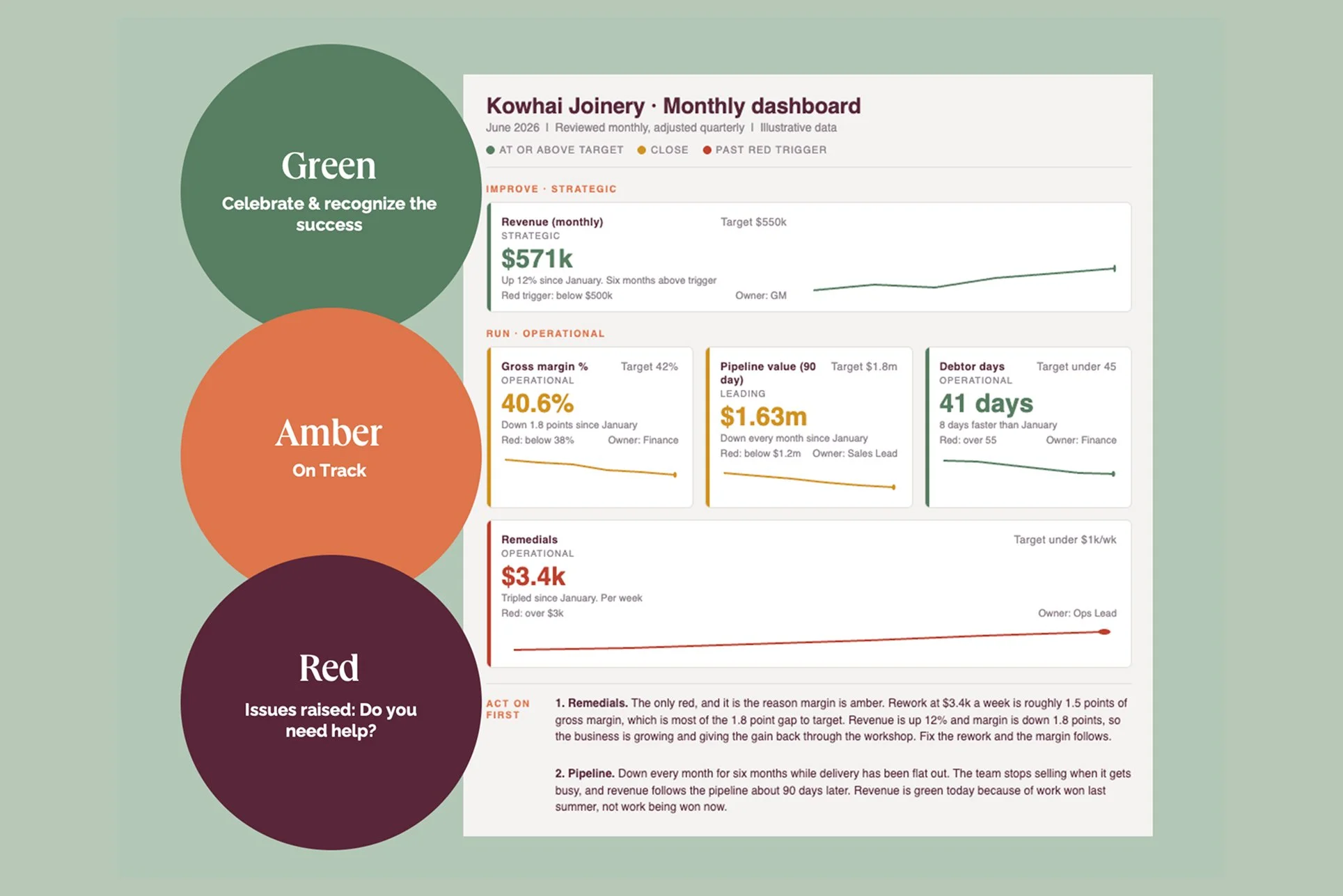
When we walk into one of the businesses we own, one of the first things we look at is the metrics: how the business is going at any given moment across the key departments, from marketing and sales through to production and installation. There are no more than five per department, and each one is red, amber or green.
The scan takes a couple of minutes. We are looking for who deserves a high five and who needs a hand. Green earns some curiosity about what that team is doing that the others could learn from. Red earns a question: looks like a tough week, is there anything the company can give you to get this back to amber? Amber, which is most of the page, gets no attention at all. On a typical page, about 20% of the measures are green, 50 to 60% are amber and 20 to 30% are red.
Most owners have no view like that, and the reason they give is usually fair enough: they are too busy putting out fires and getting to customers.
That is mistaking urgent for important, the idea behind Stephen Covey’s quadrant. It is also Run & Improve, one of the seven P16 Principles. A leader has to assign capacity to working in the business and on the business, and “there is always another fire to put out” is one of the clearest signs the second has been squeezed out. Looking at your numbers is work on the business, so it goes first, even though it would tell you why the fires keep starting. If you are in chaos mode, the energy to build the system is hard to find, which is why many owners get help setting it up the first time.
First, what is a KPI, and why does it matter?
A KPI, or key performance indicator, is a metric tied to a goal or target that tracks how well you are performing. Revenue, margin, forward work and website conversion are common examples.
The part most businesses skip is the goal. Start with your true north. That might be a vision statement, or it might be a number, such as turning over $5 million or taking $1 million out of the business next year. It does not need to look visionary to anyone else. It needs to exist, and every KPI should trace back to it, because without one you end up somewhere by accident instead of on purpose. Many owners pick KPIs because they were told they needed some, or copy the ones another company uses, and end up with measures that look sensible and change nothing.
Not every measure weighs the same
Say your margin is locked in by a customer contract. Tracking it as a KPI will not change anything you do, because the hard work is already done. Now say you know that ten outbound calls a day wins you one new customer a week. A target of twelve calls a day lifts your output by about 20% over a month. Both are measurable, and only one changes how anyone spends their day.
That is the difference between lag and lead measures. A lag measure is an outcome: revenue, gross margin, profit, the cash in the bank at month end. A lead measure is an input you control: the calls you make, the proposals you send, how many people are searching your name. Owners care most about the lag numbers, and fairly so, but you can only manage the leads that produce them.
Ask a finance lead, a salesperson and a marketer to grow profit and you will see why this matters. The finance lead cuts costs, the salesperson sells more and the marketer spends more. Everyone works hard in a different direction, and the team ends up disengaged. A good set of KPIs gives them all the same one.
Why pass or fail makes KPIs feel awful
Most companies that track KPIs run them as pass or fail. Miss for three weeks and you worry about your job, so people stop wanting to talk about their numbers. Beat the target and you get a pat on the back, then the target is lifted straight away or you start from zero next month.
Red, Amber, Green swaps the verdict for a response. For each measure, set the trigger: what counts as on track, and how far above or below that it turns green or red. Then:
Green: celebrate, at a size that matches the win. It might be a high five, an email or a bonus.
Amber: on track. Amber is great, and it gets no attention.
Red: ask who needs help.
Colours also travel. If design has had three green weeks in a row, there is a tidal wave heading for scheduling and manufacturing, and they can get ready. A team with spare capacity can see where to put their hand up for someone else’s red.
The first few cycles are the hardest, because people see a red and feel embarrassed. Not long ago in one of our own meetings, there was a single red, and the person presenting it opened by explaining why it was fine. That is wasted energy, and it is what a blame culture produces. After a few weeks of reds being met with offers of help, the response changes, and people start to be proud of putting reds up. The leader’s new problem is prioritising help, since there is only discretionary effort for about 10 to 15% of the business at a time. A page that is half red usually means the measures are wrong.
Triggers need adjusting too. If a measure has been green for six cycles, raise the trigger and save the high five for something new. If one has been red for six weeks, it is not a blip. Drop the trigger so it reads amber, give that part of the business dedicated time, and raise the trigger again every couple of weeks as it improves.
The Remind part
RAGs are the Remind part of Goal, Role, Remind. Nobody needs to read the vision statement aloud every morning. The measures connect what everyone does each hour of the week to where the business is heading, and they should change behaviour and attention day to day. A measure nobody acts on is a vanity metric, in the same bucket as a number that exists only to justify a bonus.
It also flips how many managers think about KPIs. A RAG is how the team tells their manager when they need help or a stretch, and it is not a way for the manager to control the team.
Try this by Friday
Pick one department and write down every measure it tracks, five at most. Next to each one, write what you did the last time it moved: recognised a win, corrected course or changed how the work is done.
If you cannot answer, cut the measure or replace it. For the ones that stay, write down the trigger for green, amber and red, and what you will do at each.
Which of your current KPIs has not changed anything you did last quarter?
On Day 4 of the Business Growth School, we build your own measures, triggers and RAGs, so you leave knowing what everyone should track daily, weekly or monthly. On the latest episode of Pints, Pies and Profits, Mike and Scott dig into KPIs and RAGs, and how regular check-ins on the right measures keep a team working together and tracking the same things.
Frequently Asked Questions
What is a KPI and why does it matter?
A key performance indicator is a metric tied to a goal or target that tracks how well you are performing. It matters because it connects daily work to where the business is heading and shows problems while they are still small.
What is a vanity metric?
A measure that never changes how anyone works. If a number does not lead to recognition, a course correction or a change in how the work is done, it should be cut or replaced.
What is the difference between lead and lag measures?
Lag measures are outcomes, such as revenue, gross margin, profit and cash. Lead measures are inputs you can influence, such as calls made, proposals sent or how many people search your name. You manage the leads to move the lags.
What do red, amber and green mean in a KPI system?
Green means celebrate, at a size that matches the win. Amber means on track, so leave it alone. Red means ask who needs help. Keep it to five measures or fewer per department.
What should I do if a KPI stays green or red for weeks?
Raise the trigger if it has been green for six cycles. If it has been red for six weeks, lower the trigger so it reads amber, give that area dedicated time and attention, and raise the trigger again every couple of weeks.
